Hard to tell when this mental fatigue is present. Sometimes it is humble and it grows lazy, drags down, fades or saps, or even drags. With the current screen-filled routines, ringing phones, people demanding Attention, blinking notifications every 35 sec our brains are not scheduled for any actual rest. Small brain resets occur for us during the day.
The good thing is you can easily get your mind refreshed up without long interval or without setting gimmicks. Mini, consistent activities work magic. Good brain games work because they knock the brain off autopilot. They remove the focus from the imbalance and switch the focus back onto the controlled stimulation.
The games are designed to be brief, user-friendly, and still effective. They are easily incorporated into life without a lifestyle overhaul. It only takes five minutes to activate the biggest brain areas without burning them out. This is the secret that drives these games.
Rather than draining it, they refill it and you walk away feeling sharper, more invigorated and more awake. Then these fast brain games are just the perfect activity while at work, in school, on the Internet, etc.
Why 5 Minute Brain Games Actually Work
A five-minute brain game is perfect, the brain is most receptive to short shots of focused effort as opposed to long, dragging study sessions. It acts as a mental reboot that disperses mental fatigue, recharges concentration and enhances the activation of the fundamental cognitive capabilities.
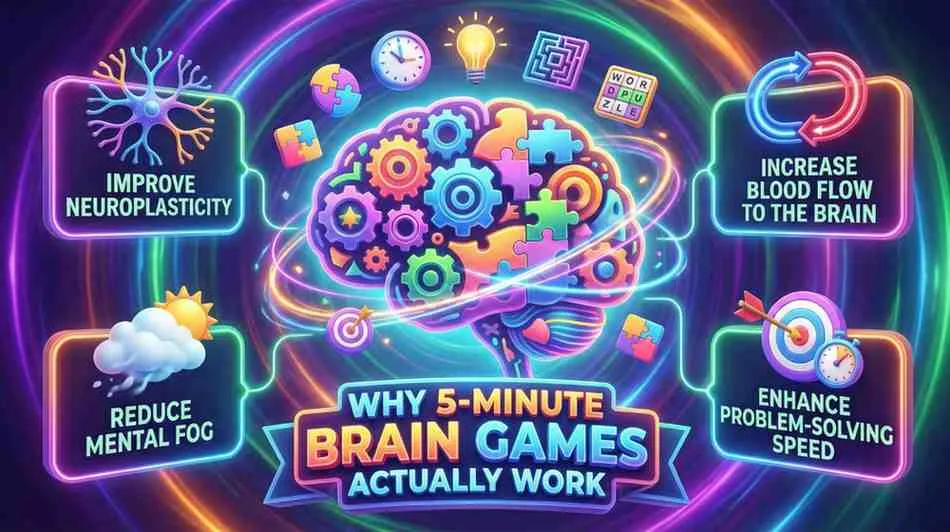
Improve neuroplasticity: Future directions include neuroplasticity, which is the brain's ability to acquire and encode new learning, apply it to previous knowledge, and restructure itself, so as to more easily aid this process and adapt to the various Learning Disabilities.
Gentle brain workouts even create new pathways in your brain! The slightest mental workout causes neurons to fire in different patterns than they otherwise would, keeping the brain's plasticity and adaptable learning capability flexible and alive. We learn, think more quickly, and are more creative!
Increase blood flow to the brain: Exercising your mind gets new oxygenated blood to your brain which clears away sluggishness quickly and increases alertness. This is why you always feel more awake after a short Brain Trainer session!
Lessen the brain fog: Brain fog is caused by information overload in the mind. Brief games seem to hit the refresh button, clearing the mind of excess information and bringing some clarity. The games allow the brain to "come out of autopilot" and refocus.
Improve problem-solving speed: Build the brain the quick way. Exercising quickly under less pressure allows the brain to become faster at analyzing, adapting and applying this thinking to real tasks.
Since the games are so short they will not exhaust cognitive resources, but still have positive effects. You can think of them as mental espresso shotsquick, stimulating, and effective, the perfect way to get your mental refreshment.
1. The 30 Second Word Switch
How it works
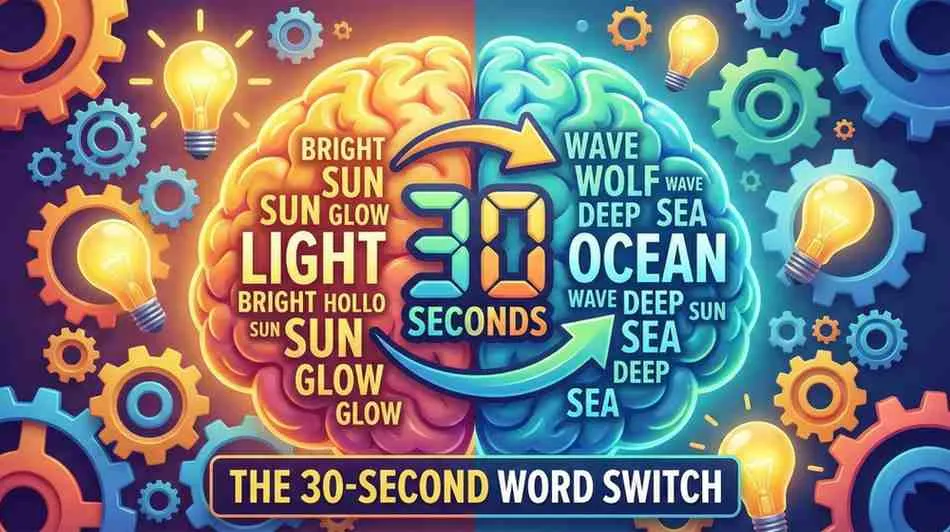
Starting with an easy single word, such as LIGHT, focus thought for 30 seconds on signing as many words as possible, with as many associations as you can, to this initial starting point. Do not stop for the duration of the time, and if your mind wanders during this time and thinks about the topic, stop immediately and switch to purely foreign words such as OCEAN and repeat.
Why it helps
This game is simply designed to increase cognitive flexibility the brain's capacity to switch comfortably and at ease between one thought and another. After weekly repetition, this game can facilitate sudden context shifts, relieving the brain from what Dweck called drive-through modes of thinking, and making it more agile. It also stimulates associations and language pathways, improving mental flexibility, how fast memories are called to mind, and neural connections of creativity, in an energising manner.
Best For:
Breaking mental blocks: Another reason for our mental block is that our brain is going through the same pathway of thoughts. By using fresh new words you can divert your brain down a completely new pathway and you use a different set of neurons to get over the icky point.
Creative thinking: Creative thinking involves establishing new linkages among unrelated ideas. Word Tapestry promotes this process and will enhance your originality, novel ideas and different points of view.
Writers, coders, designers: All of these types of fields tend to require tons of switching between context and ideation. This game does both of those tasks so it will be the perfect game to reset your mind when you are stuck in the middle of a work project.
2. Mental Math Sprint
How it works
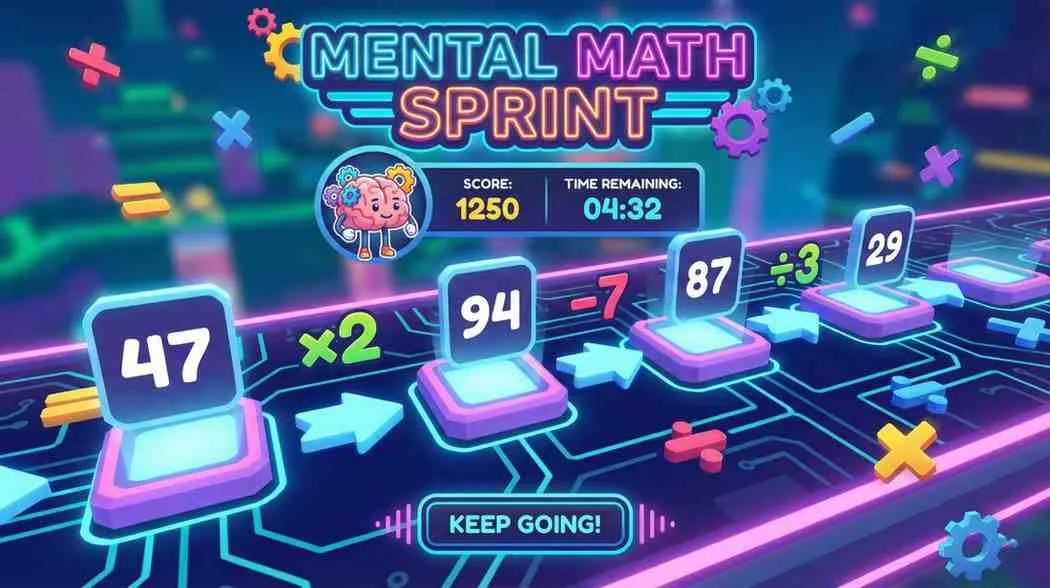
Provide a typical American with any two-digit number chosen at random and initiate a series of calculations which he will do entirely in his mind: multiply by a, subtract b. Divide by c. Keep inserting n in 5 minutes instead of b or other new input and beat the computer at the game.
Example:
47 → ×2 = 94 → −7 = 87 → ÷3 = 29
Doubling it again for a 94.7 of that to give an 87. Divided by 3 for 29, there is the possibility now to keep adding, multiplying or dividing. The sequence is changing constantly and keeping the brain alert and working for the whole of the session.
Why it helps
The reasoning, focusing and making a decision section of our prefrontal cortex is heightened when we do mathematical exercises mentally. Because it is an inward process it takes energy from every corner of the brain; concentrating and not allowing distractions is strengthened and that part of the brain learns to work more efficiently.
Best For:
Analytical thinking: This game trains the brain to process information logically and sequentially. It sharpens reasoning skills and improves accuracy in problem-solving situations that require mental precision.
Students and professionals: For people who work with numbers, data, or structured thinking, mental math acts as a quick cognitive warm-up. It helps transition into focused work modes efficiently.
Reducing distraction: Because the brain must track multiple steps, there is little room for wandering thoughts. This makes the game effective for regaining focus after interruptions.
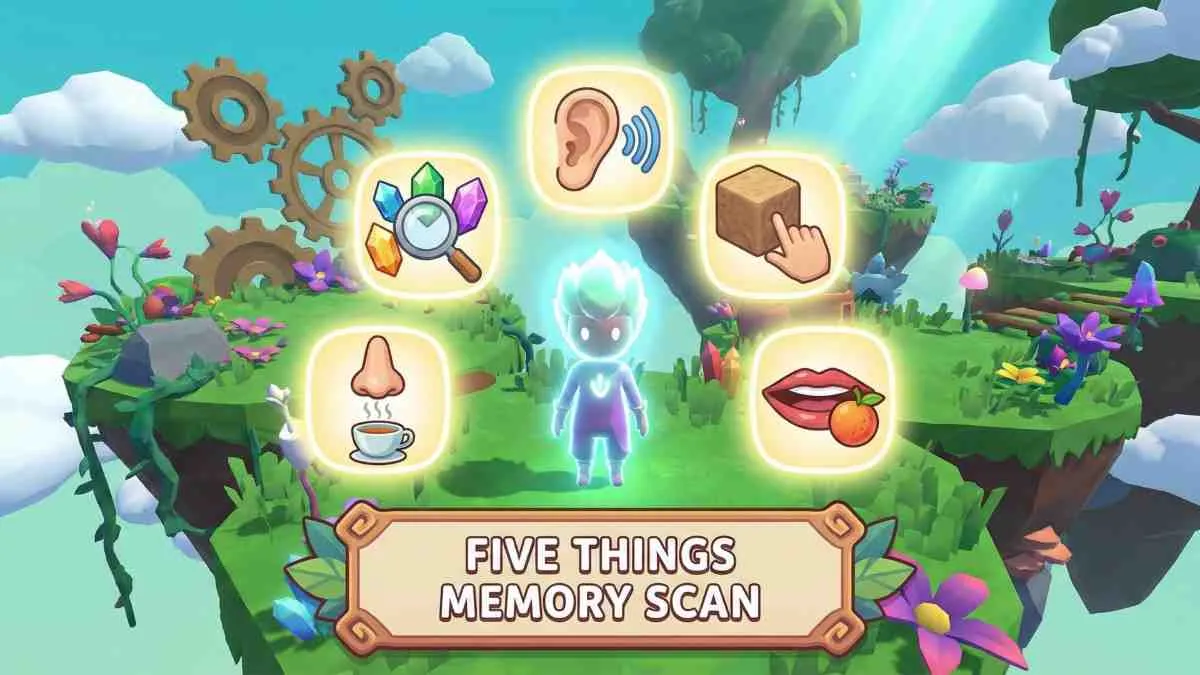
3. Five Things Memory Scan
How it works
This exercise guides your attention through your senses in a structured way:
- Five things to be seen
- Four sounds you can hear
- Three things you can touch
- Two things you can smell
- One thing you can taste or imagine tasting
Bring your attention to the present again.
Why it works
This game combines mindfulness, memory, and sensory awareness. The outward focus gets the mind away from excessive rumination and internal stress loops. It is relaxing for the nervous system while tenderly heightening awareness. It is excellent for emotional and mental resets.
Best For:
Stress relief: By focusing on the physical it is possible to relax the mental body. The brain switches from overtaxed thought to gentle awareness and relaxes with less emotional clutter.
Anxiety reset: Anxieties are generally about the future. This helps bring the mind back to the present to cut deep into any anxious spirals.
Mental clarity: This game denoises the mind by giving mental clutters missing object to focus on. This is the most exciting cognitive game to denoise in a while. Thoughts seem lighter. It gets easier to focus within minutes.
4. Pattern Spotting Challenge
How it works
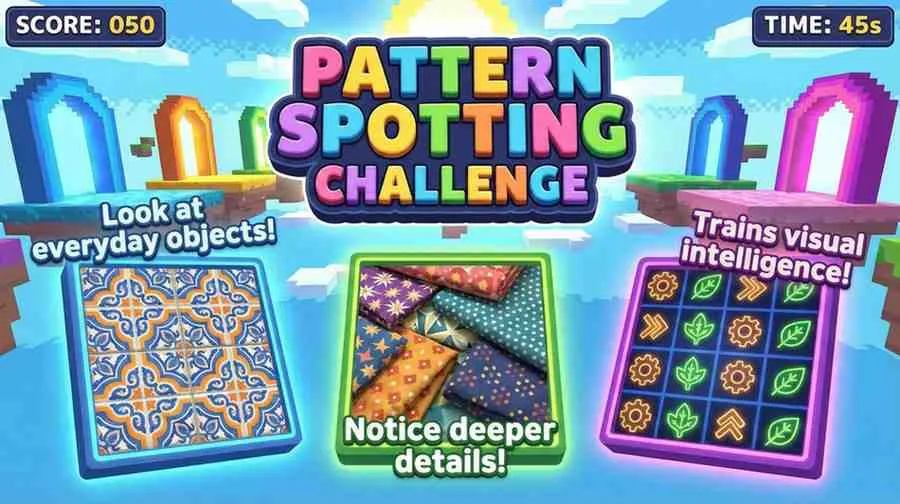
Looking at the objects surrounding outlines, icons, wallpapers, fabrics or digital images you attempt to find repetitions or sequences. Your challenge is to discover more complex, hidden structures or rules, such as repetitions, symmetries or logical sequences.
Why it works
Pattern recognition is a very important area in the realm of problem solving and intelligence and an exercise of this would be to improve the way the eyes process and analyze visually. Instruction to the brain in this regard means that lenses find a pattern in what is dull so that the eyes see what matters.
Best For:
Developers: It is not surprising that code has so many common attributes. Pattern recognition is heavily involved along with logical pattern tackling. System design uses the same muscles.
Data analyst: Finding trends, anomalies, and relationships is one of the fundamental data activities. Pattern spotting develops those skills inadvertently in a relaxed setting.
Strategic Thinkers: Those who plan, optimise, or design systems can take advantage of better pattern awareness. It improves pre and structuring thinking.
5. Alphabet Category Game
How it works
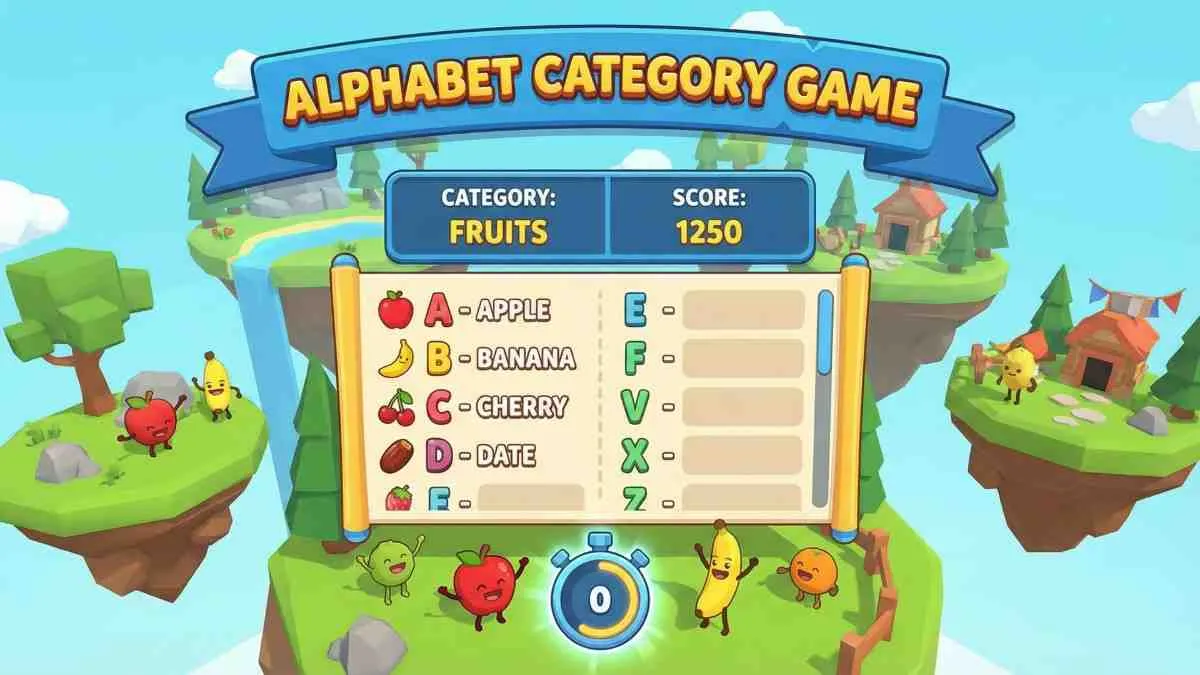
You begin by picking a relatively easy category like: objects in the house, names of movies, countries, flowers, colors, animals, names of people you admire, names of criminals, fruit, cities, professions, etc. and go through the alphabet from AZ stating one item per letter, as quickly as possible. Whenever you reach a blank, take a couple of seconds break and continue speaking after the next response enters your mind.
Example:
In the category of fruits, you could choose for instance, Apple starting with A, Banana with B, and Cherry with C. The longer the chain, the harder it is, and so you make your brain search these answers deeper and deeper.
Why it helps
This game fires off many language centres simultaneously. It integrates the retrieval of memory and the conception of new vocabulary with a fast-paced rhythm, keeping the brain excited and energised. The level of difficulty gradually rises with using the game so the brain remains stimulated but not too much.
Best For:
Vocabulary building: The game encourages you to recall words you may not use daily. Over time, this strengthens vocabulary retention and word recall.
Verbal fluency: Rapid word retrieval improves how smoothly thoughts translate into language. This is especially helpful for speaking, writing, and communication-heavy tasks.
Mental agility: Switching letters while staying within a category trains flexible thinking. The brain learns to adapt quickly and efficiently.
6. Reverse Recall
How it works
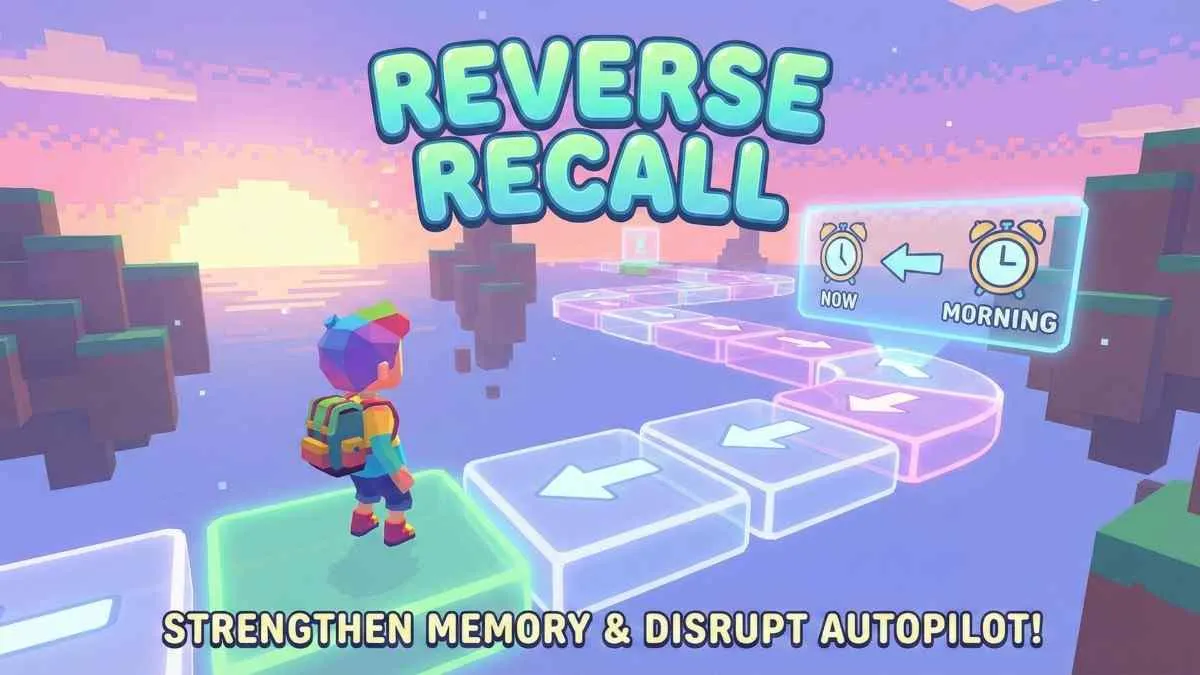
You think back through your day in the opposite direction, starting at the present and going backwards, so you remember what you just did, then what occurred before that, and so on, until you work your way back to earlier time frames.
Why it helps
Reverse thinking confuses the mind because it is contrary to the way we normally remember things. It stimulates the working memory and requires slightly more mental effort. It also breaks the autopilot aspect of thought.
Best For:
Mental clarity: Reversals aid improved attention and recall. They keep the brain alert.
Evening brain refresh: This game is fantastic at the end of the day. It helps you to calmly process the events of the day and clear away the mental cobwebs.
Memory training: Carefully revisiting information in reverse order allows the brain to encode the material in an organized manner that results in greater consistency of memory over time.
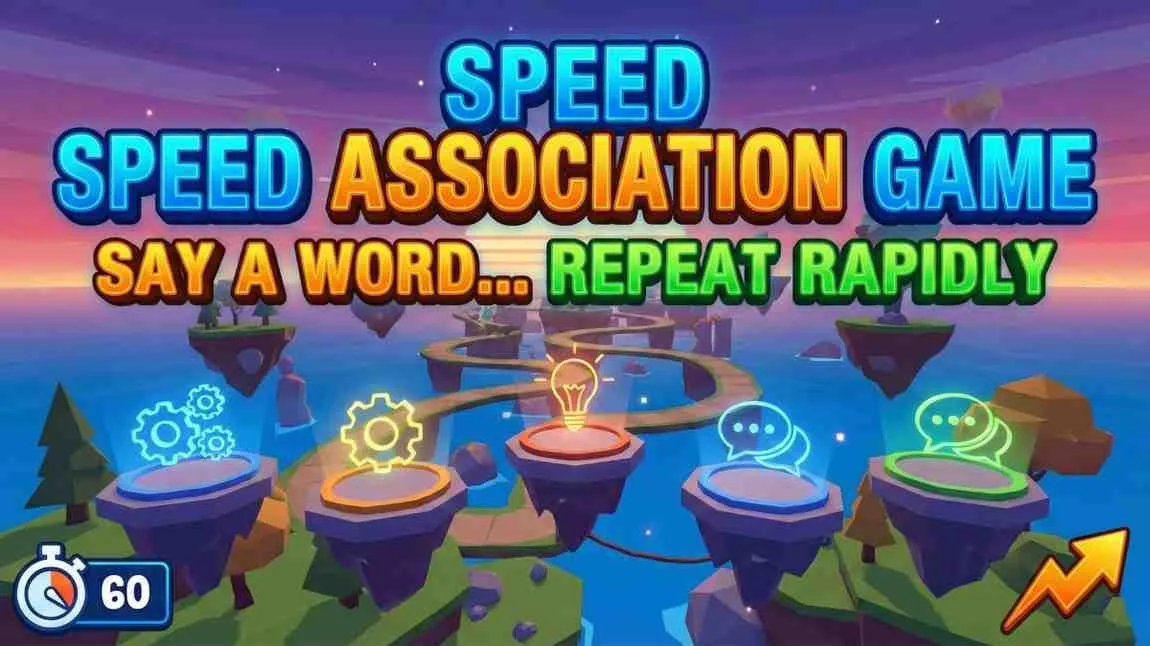
7. Speed Association Game
How it works
Say a random word out loud or in your mind and then say the first word that occurs to you out loud. Do not pause or censor yourself and keep saying any word that comes to mind so you get a very fast chain of words.
Why it helps
This game helps speed up processing and works the neurological connections that are used for creative thinking. It bypasses the thinking process and takes the brain to a natural way of thinking, improving free thinking and the flow of ideas.
Best For:
Idea generation: Rapid associations help spark new ideas and unexpected connections, making this game useful during creative blocks.
Overcoming mental fatigue: When the brain feels tired, this quick-fire exercise reactivates thinking without requiring deep effort.
Quick thinking: The game trains instant response skills, which are valuable in discussions, problem-solving, and fast-paced decision-making.
How to Make These Games a Daily Habit
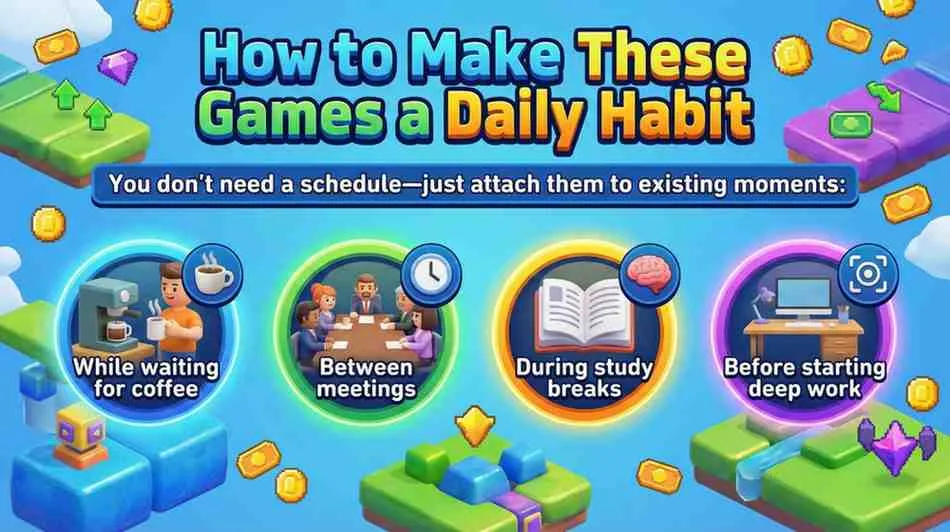
It can also be surprisingly simple to incorporate the brain games into your schedule without it even needing to be included in your daily routine as it will simply become too routine to be considered a burden in the end, the challenge is to connect the games with circumstances or tasks that happen all the time and that you are so accustomed to that it would not even seem worth mentioning a change on your end.
While waiting for coffee: Don't mindlessly scroll through your phone use those downtime minutes to do a quick brain game. Spending that extra time in the morning is like a warmup of your brain!
Between meetings: The best way to clear your mind in between sessions is to take a short break. Five minutes of the game clears the mind and helps to prepare for the next topic of discussion.
During study breaks: Brain games in break moments use your brain actively without making you tired. It prevents you from getting exhausted, and at the same time, it keeps you going, so learning later will be easier.
Before starting deep work: Playing a quick brain game before diving into demanding tasks primes your attention and speed of thinking so that you can achieve your flow faster and clearer.
If you alternate between the games and don't invest too much in each of them, the activities should become enjoyable and useful at the same time, making your focus, productivity and wellbeing stay "up" during all hours of the day.
Final Thoughts
Can your quick break refresh your mind in just minutes? Obviously, 5 minutes of playing a right-brain game, which is intended to be short, stimulating, and fun, will revive the brain, boost the memory, and better reduce fatigue than treading water on the screens.
Admittedly used often, and as prescribed, fast brain games are like exercising your mind every day. They enhance your thought pattern, develop your creativity and keep you mentally agile amidst the various commotion. Practice in small doses and persist, and in a five-minute rest, you will find your brain feeling fresh as a daisy.